

What You Get
- Alerts posted to any Slack channel the Ultra app has been invited to, public or private
- A severity filter per channel, so a high-traffic channel only gets what matters
- A link on every message that opens the alert in Ultra Hub
Prerequisites
- Owner or admin role in Ultra Hub
- Permission to install apps in your Slack workspace
- At least one alert source switched on in Alerts configuration. A channel only receives alerts from sources that are switched on.
Set Up Slack Alerts
1
Connect your Slack workspace
In Ultra Hub, go to Settings > Integrations. Under Available integrations, click Add next to Slack.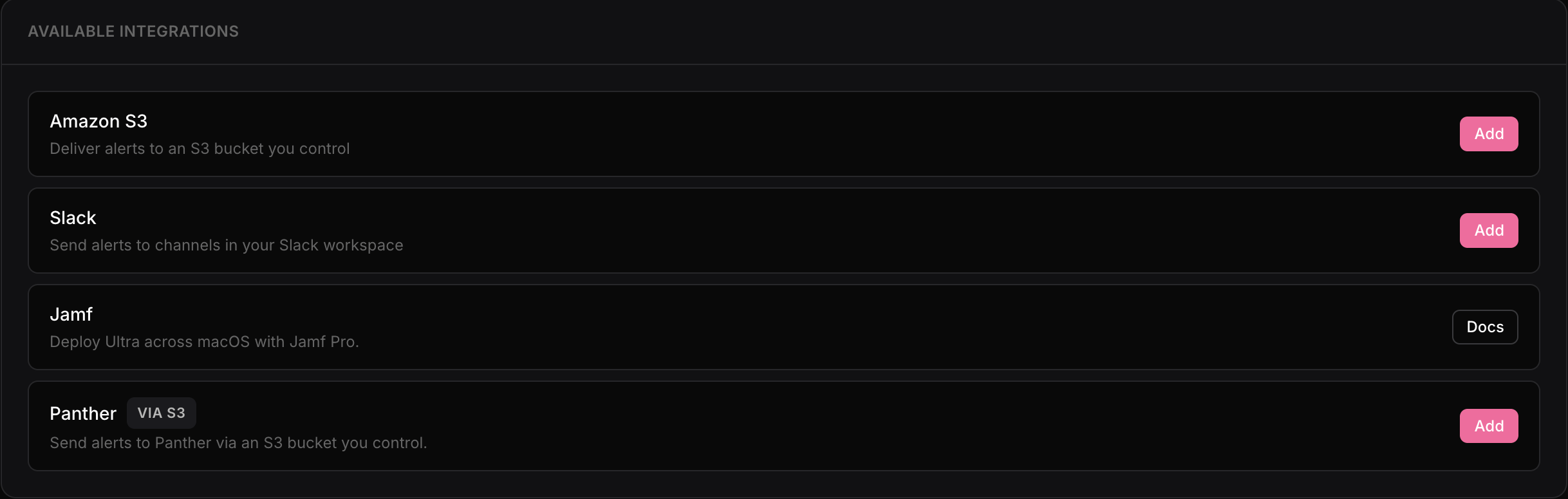
Ultra cannot read messages in your workspace.After you approve, you return to Settings > Integrations and your workspace appears under Connections.
A Slack workspace can be connected to only one Ultra organization.
2
Invite the Ultra app to a channel
In Slack, open the channel you want alerts in. Open the channel details, go to Members, click Add people or agents, search for Ultra, and add the app.You can also type
@Ultra in the channel and click Add Them when Slack offers to invite it.For a private channel, the app must be invited the same way. Ultra never sees a private channel it has not been invited to.3
Refresh channels in Ultra Hub
Back in Ultra Hub, open your Slack connection under Settings > Integrations and click Refresh channels.The channel now appears under Channel routing. A channel is listed only after the Ultra app has been invited to it, so if you don’t see yours, check that the app is a member and refresh again.Repeat the invite for as many channels as you like. Each one is routed separately.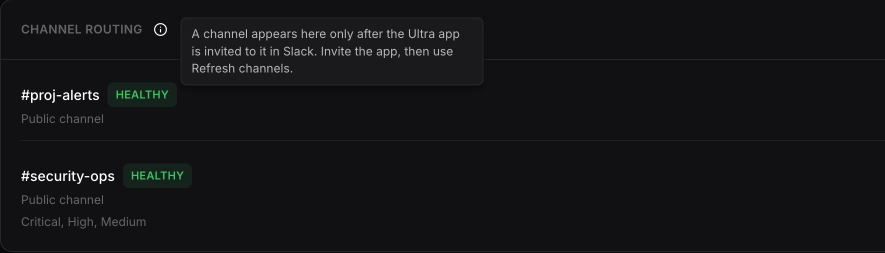
4
Turn on alerts for the channel
Click … on the channel’s row and choose Enable alerts. The row changes to Alerts on.By default a channel receives Critical and High alerts. To change that, click … and choose Edit severities. Under Send alerts for, check the severities you want (Critical, High, Medium, Low, or Informational) and click Apply. The selected severities are listed under the channel name.
5
Send a test alert
A newly enabled channel shows as Unverified until Ultra delivers its first alert to it. To confirm delivery now instead of waiting for a real alert, send a test:
- Go to Alerts and click Configuration in the page header.
- Click Test on any alert source, then Send test.
Test: followed by the source name, with the context Test. Once it is delivered, the connection and the channel both change to Healthy.The test alert has to match the channel’s severity filter to be posted. A test is sent at High for a guardrail in Block mode, a governance block rule, or anomaly detection while it is on, so it reaches a channel on the default filter. A test for a guardrail in Redact or Monitor mode is sent at Medium or Low, and will not reach a channel filtered to Critical and High.
Alert Messages
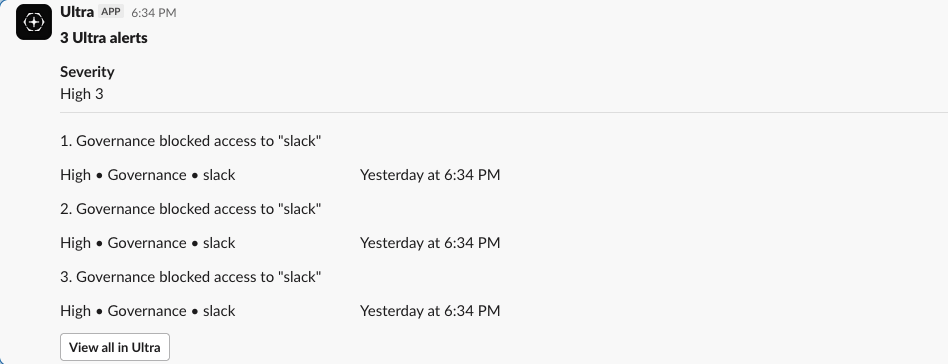
A single alert is posted as a card with the alert title, Severity, Source, Context, and Observed time, plus a View alert in Ultra button that opens that alert in Ultra Hub. The time shows in each reader’s own timezone.
Health Status
Your Slack connection and each channel with alerts on show a health status.Change or Remove a Channel
- Change severities: click … on the channel and choose Edit severities.
- Stop alerts: click … on the channel and choose Disable alerts. Alerts queued for that channel are dropped, and alerts raised while it is off are not sent later.
- Remove a channel: disable its alerts in Ultra Hub first, then remove the Ultra app from the channel in Slack.
Disconnect Slack
Click … on the connection card and choose one of:- Disconnect workspace: turns off alerts for every channel, drops any queued alerts, and revokes Ultra’s access to Slack. The connection stays in Ultra Hub so you can reconnect it later. After reconnecting, turn alerts back on for each channel.
- Delete connection: does the same, then removes the connection from Ultra Hub. This cannot be undone. To confirm, type
Deletefollowed by the connection name (for exampleDelete Ultra) and click Delete Connection.